Tuesday, 25 June 2019

Post-truth truth post


We seem to be living in a world dominated by those who bluster best.  It is time to be concerned when facts can be dismissed as less important than dogma.  Ideology is important, even when driven by emotion, but it must be consistent with whatever scientific evidence is available if it is to contribute to our collective and sustained wellbeing.

The statements we make to inform policy and practice are based on independent scientific research carried out, either by us or by others, even when the results of that research are not totally aligned with what we may have expected or hoped for.  We adapt the way we think according to our findings.

Most recently, evidence from our published research over the years was used to support the case for targeted control of crows and magpies for the conservation of certain predation-prone species such as spotted flycatcher and song thrush.  Many years ago, we investigated and tested the potential of wild bird seed crops which subsequently became adopted nationally as a popular Stewardship option.  We provided evidence for the role of supplementary winter feeding as a means of increasing songbird survival and breeding numbers.

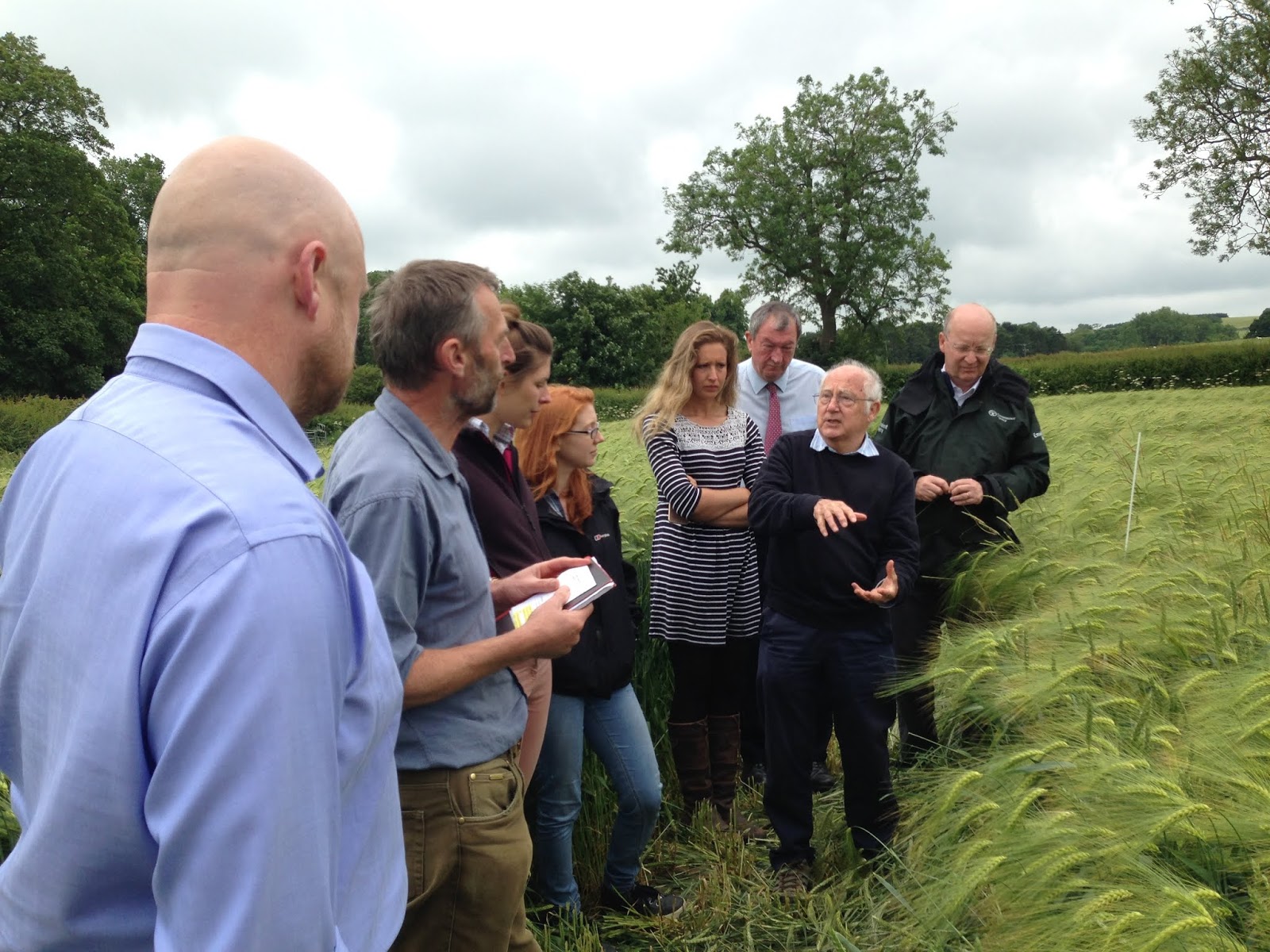
Discussing cover crop research results with EA CEO, Sir James Bevan
Our research continues to inform decisions about both national policy and on-farm practice.  We highlighted the impact that sewage treatment works and septic tanks have on water quality where the blame had previously been laid wholly at the door of agriculture.  We discovered that detention ponds designed to reduce sediment movement to streams rarely did so on our clay soils, although they were fine on lighter land.  We identified environmental benefits of cover crops and direct drilling, but also the challenges associated with them on our soil type, and sometimes the economic cost.

Where are the people in all this science?  We recognise that, amongst the farmers, agronomists, conservationists, policy makers and regulators we work with, there are differing knowledge cultures, between and within these groups.  That is a subject I touched on in a recent journal paper on our participatory research with farmers and others.  We previously adopted a social learning approach to improve our collective local community knowledge of land use and environmental issues in the Eye Brook catchment, and we have studied how farmers learn through their practical experience of Stewardship schemes.  Such integration of research disciplines is important for a comprehensive understanding of often complex issues.

We are learning new things all the time. Our perceptions of truth evolve.  But our statements are based on our understanding of the situation following research, not before it, and certainly not in denial of it.  It is at the heart of all we do.  No bluster.


Wednesday, 5 June 2019

Grass is getting us integrated

Our research focus has historically been very much on the arable environment with research covering arable ecosystems, soils and catchment processes.  Given that our farm at Loddington is primarily arable, this will probably always be so for as long as the current land use is maintained.  But we also have grass on the farm and are located in a mixed farming landscape in which many farmers focus on livestock or a combination of livestock and arable cropping.

In recent years, I have been able to increase the research we are doing on grass and livestock systems.  From 2015, with Nottingham University, we explored the spatial variation and seasonal changes in important trace elements in grass swards as part of our contribution to Defra's Sustainable Intensification research platform (SIP).  An improved knowledge of this issue enables farmers to make informed decisions about which fields to use for grazing lambs or ewes, or to cut for silage that will be fed along with mineral supplements.  Such knowledge also helps farmers to decide how best to include grass leys in their arable rotations, helping to contribute to wider catchment management objectives.

Fenced and unfenced sections of experimental deep-rooting grass ley plots for the SoilCare project
Also within the SIP, and along with our partners at Rothamsted Research's North Wyke research farm, Bangor University's research farm at Henfaes, and Nottingham University's Vet School we carried out a study exploring the means of reducing greenhouse gas emissions from grazing ruminant systems, and with NIAB and Newcastle University, we investigated the obstacles and opportunities associated with introducing grass leys into arable rotations.

Within our EU funded SoilCare project, we have set up replicated experimental plots to explore the potential of several modern deep-rooting grass cultivars to meet the multiple objectives of farmers and wider society.  Together, these research projects give us much more to talk about with our livestock farming neighbours, and of course with the thousands of other agricultural professionals who visit us from further afield each year.

Tuesday, 7 May 2019

Participatory research in the Welland river basin

We have been carrying out research into soil management and catchment management at Loddington for many years.  Throughout, our aspiration is to identify or develop methods that will meet multiple objectives simultaneously.  That means benefits to the farmer adopting the management practice, and benefits to wider society such as improved water quality, reduced flood risk or enhanced biodiversity. 

That is not something we can achieve on our own but involves a series of interactions with a wide range of people with different interests.  The way we do this varies. It may simply be capturing feedback on existing research, or enabling others to set our research agenda, or actively involving farmers and others in the research, often on their own land.  The approaches range from 'consultation' to 'co-production'. 

Such a participatory research approach has long been adopted in primarily agricultural countries across Asia, Africa and South America, and I have adopted this approach myself when working with West African farmers managing a groundnut/millet rotation on severely degraded soils.  But participatory research has been adopted in the rest of the World only much more recently.

Together with colleagues at Nottingham University, I recently published a journal paper which evaluated five research projects that we had carried out in the past five years across the spectrum of engagement. The paper is available here for a limited period.

In these projects, we work with members of two local farmer groups, farmers in our landscape scale Water Friendly Farming project, and members of the Welland Resource Protection Group.  While the farmer groups provide our link to a range of active farm businesses, the Welland Resource Protection Group comprises a much wider range of people spanning farming and wider societal interests.  The range of expertise represented in this group ensures that multiple objectives are addressed in guiding future research. The research also feeds into farmer workshops coordinated by members of the group, providing a link back into the farming community so that new participants with new ideas can constantly be recruited.
Welland Resource Protection Group members discuss a soil management experiment at Loddington

Wednesday, 20 February 2019

Farming on the edge

A new book, The Ecology of Hedgerows and Field Margins published this month sheds new light on the network of hedges, ditches and grass margins that form an integral part of the landscape across most of lowland Britain.  Once serving an important livestock control function in farming systems, field margins subsequently became valued for their wildlife.  As such, they were regarded as almost independent of the farmed land each side of them, a linear oasis in an environment in which the fortunes of wildife had taken a substantial turn for the worse.  As field margins were defined almost exclusively as hedges, and the quality of those hedges for both wildife conservation and livestock containment had declined, the initial emphasis was on improving hedge management for wildlife.  Chapters on plants and butterflies are provided by former GWCT researchers, Phil Wilson and John Dover, the book's editor.

Field margin at Loddington, comprising hedge, ditch and herbaceous vegetation
The book brings together research results that contribute to more enlightened management of hedges for wildlife.  But field margins have become recognised as being much more than hedges.  As well as ditches, they include a range of habitats, specifically designed to benefit wildlife, features that are relatively new to the farmed environment.  They provide an example of how our landscapes continue to evolve in response to our developing knowledge, values and requirements.  Increasingly, and importantly, they are recognised as being an integral part of the wider landscape.  Many bird species nesting in hedges gather their food from the adjacent farmland, or from land managed for wildlife in field margins for example.  GWCT's Nick Sotherton provides a chapter on management of field margins to increase invertebrate food for birds.

And increasingly, there are demonstrable benefits of field margins to food production in the adjacent fields.  GWCT researcher, John Holland covers beneficial invertebrate predators of crop pests for example. Another chapter covers the role of field margins in supporting pollinating insects which contribute to the pollination of oilseed rape and field beans, as well as fruit trees, soft fruit and hedgerow shrubs.

In my own chapter, I provide a summary of the relevant research that has been carried out at Loddington over the years, including that on field margin wildlife which has its own intrinsic (non-monetary) value.  But there are also the ground and rove beetles, spiders, bumblebees, solitary bees, earthworms and others for which field margins play a crucial role, and which also influence our ability to produce food from the land.  Not 'just' wildlife, but an essential part of our own ecology.  As our understanding of them continues to grow, the importance of field margins in our lowland landscapes becomes increasingly apparent.