Friday, 19 April 2013

'School Farm' demonstration catchment

After more than twenty years of farming and data collection, we have a valuable set of records for our farm at Loddington.  This is especially so for the 140 hectare catchment in the northern part of the farm where, as well as data on crop inputs and yields, soil nutrients and bird distribution, we have an important aquatic dataset for a three year period from the Defra-funded 'PARIS' project. This includes nutrient concentrations, aquatic invertebrates and diatoms.

The GIS base map for the catchment has recently been completed by Linnea Aronsson, providing a resource that will have a number of applications.  As the map shows, the catchment is a microcosm of lowland England, comprising an ancient semi-natural SSSI woodland, other more recent woods and hedges, cropped land and pasture, of which the latter is used for lamb production, and for horses.  There are rural houses and roads, ditches, streams and ponds, and habitats created specifically for wildlife under our Environmental Stewardship agreement.

We are developing this catchment as a practical demonstration of ecosystem services, the various benefits we gain from the environment and the interactions between them.  To this end we installed new water monitoring equipment at the base of the catchment last year, mapped the breeding birds, and surveyed earthworms, soil microbial biomass and soil organic matter in relation to the three major land uses – arable, pasture and woodland.  This initiative provides an exciting opportunity to explore how we maintain or increase food production to meet growing demand, while simultaneously delivering all the other resources our society demands of the agricultural landscape. 

Friday, 22 March 2013

Exploring a Productive Landscape

Here are a few comments from prominent readers of my book.  It is available as a free pdf HERE.

Jonathan Dimbleby, current affairs presenter, organic farmer and former president of the Soil Association and Campaign to Protect Rural England (CPRE). “This book is a great example of the ‘Big Society’ in action.  Skill, expertise, dedication and enthusiasm have brought together, in one small place, a host of very important issues that face the whole country.” 

Mary Creagh MP, Shadow Secretary of State for the Environment Food and Rural Affairs.  “There is a growing body of evidence about the impact of climate change and human behaviour on our environment. Yet too often policy and science is developed at an abstract level. ‘Exploring a productive landscape’ provides a practical example of the benefits of involving people in the environmental decisions that affect their community, and their role in creating a sustainable future. It tells the story of how a community project in Leicestershire has responded to the challenges it faces and draws wider lessons on the issues of land management and conservation.”

Jim Paice MP, former Government Farming Minister. “The Defra Business Plan recognises that the environment is the natural foundation on which our society and economy are built and that our long-term prosperity, economic success and quality of life are enhanced by our environment.  As this book highlights, if we use and manage our natural assets in a sustainable way, they will continue to meet not only our needs, such as for energy, sustenance, minerals, fresh water, clean air and fertile soils, but the needs of future generations.”

The Right Reverend Tim Stevens, Bishop of Leicester.  “This excellently produced book reveals how the farmed landscape shapes everyone’s lives, despite most being far removed from that environment.  It will stimulate the debate over how the farmed landscape should be used in the future.”

Saturday, 9 March 2013

Blueprints for landscape management?

The Welland Valley Partnership, a consortium chaired by the Welland Rivers Trust and comprising GWCT, NFU, CLA, EA, Anglian Water and others with an interest in the Welland river basin recently celebrated its first year with the publication of its 'Improvement Plan' for the catchment.  One of the first Defra pilot catchments for integrated management, the Welland has been at the forefront of the pilot process which ended in December, and with the publication of the plan.  But what really matters is the work going on on the ground, and as the plan documents, there is a lot of it. Projects include restoration of the Stamford mill stream, fish passes and river habitat improvement, a river restoration project in Market Harborough, workshops and one-to-one advisory visits for farmers, capital grants for measures to improve water quality, and a campaign to improve the management of septic tanks.  Although initiated in response to the legal requirements of the EU Water Framework Directive, the strength of the Welland plan lies in the commitment and enthusiasm of local people with differing but related objectives.

At the core of the activities in the Welland is our own Water Friendly Farming project in the headwater tributaries of the Eye Brook and Stonton Brook and our other research at and around Loddington. Water Friendly Farming builds on our previous work in the Eye Brook which combined our scientific knowledge of the agricultural environment with local knowledge in the catchment community to explore a whole range of issues associated with the management and use of natural resources.  An account of the Eye Brook work was recently published as a journal paper which can be downloaded HERE.  For those who don't have the time or inclination to delve into an academic paper, here are some under-pinning principles which can be adopted or adapted to local circumstances in other areas:
  • Combining scientific research with local knowledge strengthens both knowledge communities to the benefit of all through an improved shared understanding of landscape scale issues and catchment processes.
  • Identifying cultural as well as economic motivators for individuals and businesses is an important element of community engagement, both within and beyond the farming community, strengthening 'buy-in' from participants. Acknowledging and accepting differences in values and objectives within rural communities is essential to the development and implementation of management on the ground.
  • Learning about land use history strengthens local identify and 'ownership' of agri-environmental problems and opportunities
  • Recognition and acceptance of the interelationship between multiple objectives (e.g. food production, water quality improvement, climate change mitigation, flood management etc) should be central to catchment management policy and practice
  • Identification and promotion of private benefits must be combined with consistent government support for activities that deliver public benefits

Monday, 4 February 2013

Soil management workshop

Good soil management results in healthy crops and clean water, but the latest research on this issue is not always accessible to farmers.  With support from the Welland Rivers Trust, the Allerton Project hosted a lively workshop for local farmers last week.  As well as our own research with ADAS on tramline management, the 35 farmers attending heard about the latest research on Michelin's tyres, including how to select the most apporopriate tyre to optimise vehicle performance and minimise soil compaction.  The role of different cultivation regimes for blackgrass control was another popular talk, and we also heard how Wessex Water supports farmers in the southwest to adopt practices that help to maintain water quality.

There was some lively discussion between talks ...

... and over lunch!

Sunday, 20 January 2013

Winter feeding and fattening


The latest available figures reveal that sixteen HLS agreement holders have adopted the new supplementary feeding option to support farmland birds in the critical late winter period when other sources of food are in short supply.  Some farmers are also adding this option to their ELS agreements.  Given the very short time in which to apply back in December, this is very encouraging and is a classic example of research by the Allerton Project (and colleagues in BTO and RSPB) being translated into practical action on the ground.

The data that we have gathered at Loddington over many years suggest that winter feeding results in more than twice as many songbirds present during the second half of the winter.  More importantly though, our results suggest that breeding bird numbers could also be up by 30%.  More food in late winter means more birds, and better survival of those birds so that more are present in the following spring.


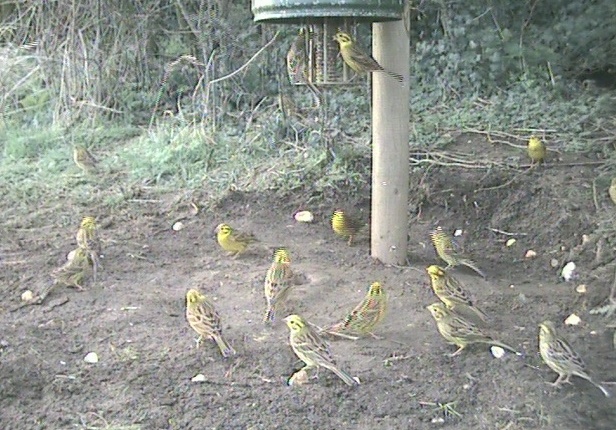
Trail Camera image of yellowhammers feeding at a feeder at Loddington


This encouraging prospect and the current snowy weather have combined to prompt me to dig out some data from several years ago when I first got interested in this issue and started catching yellowhammers through the winter to see how much fat they were carrying.  Birds lay down more fat as the winter progresses - insurance against uncertainty associated with cold weather, shorter days, snow cover and depleted food reserves.  In late winter, fat levels decline and birds become more vulnerable to starvation.


Yellowhammer body condition index, reflecting fat reserves (1995/96 data).


I also have some results for the same period from the Rybachy bird ringing station on the eastern shore of the Baltic.  Fat reserves in yellowhammers are very different here, and considerably higher in the autumn than they are for British birds.  The reason is that Russian birds are laying down fat to fuel a southward migration, rather than to survive the winter on the same site.  There are no data for the winter because the birds have gone!

The low fat levels in the British birds in March serve to highlight the need for supplementary feeding in the scond half of the winter, but especially at the end of the winter when the food supply is at its lowest.  But these data are also a reminder that the same species can behave differently in different countries.

Saturday, 5 January 2013

Water Friendly Farming update

Record rainfall on waterlogged soils at Loddington over the past few months (see Loddington Estate Blog) has brought farming activity to a halt and has flooded local roads, but research activity has also stepped up in response.  Following two dry winters, the recent rain provides opportunities for sampling water in the streams at Loddington and in the three headwater catchments of the Water Friendly Farming project.  The resulting data will contribute to an essential baseline against which to measure improvements in water quality over the next few years.  


Allerton Project Ecologist, John Szczur, processing water samples from one of our automated water samplers before despatching them to the labs for analysis.


The improvements in water quality are expected to arise as a result of a range of measures that will be put in place across the 20km2 agricultural landscape of the upper Eye Brook and Stonton Brook over the next year or so.  It is a big task in terms of the scale of both the monitoring and the mitigation, but on our side we have strong support from the farming community and experience gained from a suite of relevant research projects over the past decade.  The physical measures that we have already started to create on the ground include field drain interceptor ponds, wetlands designed to receive surface runoff, and carefully sited dams in ditches.  These will be backed up with practical advice to farmers, and we have not forgotten domestic sources of nutrients such as septic tanks.

Watch this space for the latest developments and results to emerge from the project, and for news of other activities on our own farm at Loddington.


Local contractor John Farnsworth creating one of the first field drain interceptor ponds to be made as part of the Water Friendly Farming project.