Saturday, 12 April 2014

Could more aquatic wildlife mean more food for us?

I make the case in a conference paper published this week* that aquatic invertebrates can be used to guide land management to improve crop yields. Driven by the demands of the Water Framework Directive for cleaner water in our streams and rivers, it is very much the vogue to use aquatic invertebrate communities as indicators of the negative effects of food production on freshwater as many species are affected by the loss of soil and nutrients from farmland to water.  But the loss of soil and nutrients from farmland to water does little for food production either!  Aquatic invertebrate communities can be considered as indicators of how well agricultural soils are being managed.
Aquatic invertebrates in a mixed arable/grass and an all-grass catchment
In our largely arable School Farm demo catchment, mayflies were present in just a third of the numbers present in a nearby low input pasture catchment stream, while caddis fly numbers were only 18% of those present in the comparison catchment. Stone flies were totally absent from the School Farm stream, whereas they exceeded caddis fly numbers in the pasture stream. It is probably unrealistic to expect invertebrate communities associated with arable land to be as rich as those associated with stable soils under low input pasture.  However, we expect our current improvements in soil management within the School Farm catchment to improve soil function, and that means benefits both to food production and to aquatic wildlife.

*Stoate, C. 2014. Delivering integrated farm management in practice: understanding ecosystem services. Delivering multiple benefits from our land: sustainable development in practice. SRUC/SEPA Biennial Conference, Edinburgh, 15-16 April 2014.

Wednesday, 2 April 2014

Water Friendly Farming project update

There has been considerable recent activity within our landscape scale experiment in partnership with the local farming community in the upper Welland river basin. Much of the work of putting in place mitigation measures across the upper Eye Brook and Stonton Brook catchments has now been completed, although there is still some work to do.  Ditch dams, flood water ponds and field drain interceptor ponds are all located outside the cropped area and are designed to trap sediment and nutrients once they have left fields. Although the main activities are with the arable farmers, some have involved improvements to livestock systems. Some initial surveys of arable soil structure and mapping soil nutrients have resulted in targeted advice to farmers to prevent soil and nutrients leaving fields in the first place and we hope to develop this work further in the coming year. We are aiming to improve the efficiency of food production, while at the same time achieving environmental benefits. Much of the practical work is informed by the research carried out with our research partners on our own nearby farm at Loddington.

The Water Friendly Farming project builds on previous activities in the Eye Brook catchment, not least the Eye Brook Community project in which researchers, farmers and other local residents improved their shared understanding of how the catchment works to deliver both food and environmental benefits. The annual newsletter, 'The Eye' was a key mechanism for sharing information locally and we have recently published another issue of The Eye in order to improve awareness of the Water Friendly Farming project amongst local residents.  You can download a copy here. As they emerge from the project, results are being shared with the national farming community and others through the ongoing programme of events held in our eco-build visitor centre at Loddington, and through our advisory activities elsewhere, including our established links with the FWAG Association across the country.

Tuesday, 25 March 2014

All you need to know about biobeds

This was the title for the final workshop of this series of three which has taken place at the Allerton Project, organised by Jim Egan, with funding from the Welland Valley Partnership and support from The Campaign for the Farmed Environment. The workshop was led by Andrew Down, a Catchment Sensitive Farming Officer with Natural England and there was a visit to the Allerton Project's own biobed which Farm Manager Phil Jarvis and team are currently building – see some pictures on his blog.

The most important step is planning what you are going to do. Looking at the overall spaying/farm yard operation is a great starting point as many farmers could use this as an opportunity to make the farmyard more efficient as well as more environmentally friendly. 
Visiting farmers discuss the Allerton Project biobed
The first decision is whether you want a biobed or a bio-filter.  If you have a covered sprayer filling area you should be looking at a bio-filter, and if you are working on an outdoor operating system then it’s a biobed that you need.  We discussed everything from permits and exemptions through to construction and costs.

If most farmers took a long hard look at how they currently operate they’ll see there are a range of environmental risks and a number of inefficient steps in the whole spraying operation.  An investment in new infrastructure might be the best way forward and hopefully this workshop helped to give some ideas as to where to start.

Forty percent of pesticides in watercourses comes from farmyards with between 60 and 100% of that coming from foil seals and tractor washings! Andrew also reminded us all that for a single pesticide the limit in drinking water is 1 part per billion which equates to 1 drop in an Olympic sized swimming pool, or just one slug pellet in a 100 metre length of ditch.  If we want to keep the chemicals we have, better managed sprayer filling systems and a biobed or bio-filter are worth considering.

Wednesday, 19 March 2014

Improved soil management giving improved yields

Another successful workshop for Welland farmers today, supported by the Welland Valley Partnership and the Campaign for the Farmed Environment.  Here's a guest blog from the Allerton Project's Jim Egan who organised the event - 


The line-up of speakers was very varied and I thought I’d share some of the key points I picked up from each one. Allerton Project Director, Alastair Leake kicked the day off by looking at why soil organic matter is important. Soil organic matter:
·         Improves seedbed quality
·         Increases water infiltration
·         Increases Water Holding Capacity
·         Helps keep nutrients available
·         Produces simple nutrients from complex organic molecules
·         Fuels the Carbon Cycle

He also talked about how worms can be a farmer's best friend!

Next up was Ron Stobart who is the Head of Agronomy Knowledge Transfer and Training at NIAB TAG. Ron was given the task of talking about rotations and how this can influence soil organic matter.  It was great to hear about some long term research and gain some new knowledge. Ron reinforced the messages Alastair had delivered. Soil organic matter influences physical, chemical and biological properties including:
·         Improved drainage/workability of heavy soil
·         Improved available water capacity of light soil
·         Improved stability of soil crumbs
·         Assists root exploration
·         Improved nutrient holding capacity
·         Releases nitrogen to plants
·         Encourages earthworms, soil fauna - those worms again!


'Why Grow Cover Crops?' was the topic that Phil Sumption from the Organic Research Centre was given. Apart from re affirming my belief that there is a lot that conventional and organic farmers can learn from each other, here are my key points from Phil’s presentation. Consider growing cover crops to:
·         add nitrogen to the system by fixation
·         prevent leaching
·         modify the availability of nitrogen and other nutrients
·         build soil organic matter and encourage microbial activity
·         prevent soil erosion
·         help with pest, disease and weed control

Last of the formal speakers was Matt Taylor from ADAS who tackled 'Recycling of Organic Materials to Land'. Again lots to learn but my key take home messages were: 
  • Know what you are applying - use laboratory analysis
  • Apply accurately and evenly - if you can use precision application machinery
  • Make best use of nutrients - NPKS costs money but can boost yield which gives a better financial return
After lunch our guests went out with Allerton Project Farm Manager, Phil Jarvis to look at what we are doing here at the Allerton Project.

Tuesday, 18 March 2014

The early bird ... loses its eggs

Early nests are more susceptible to predation
The nesting season is underway for bird species such as blackbird and song thrush, but their nests are poorly concealed as the leaves are not yet on the trees and hedges. Analysis of our 11-year dataset by Patrick White previously revealed that early season blackbird nests were more susceptible to predation by crows and magpies than nests later in the season, although there was no such effect when nest predators were controlled as part of a game management system (1).  That work also revealed higher fledging rates and population increases during the period of low nest predation.

In another paper just published on-line (2), Patrick White's further analysis of nest data collected over the same period by John Szczur reveals that, as well as blackbird and song thrush, nest survival of dunnock, chaffinch and yellowhammer also benefited from the removal of nest predators during the breeding season as part of systematic game management. For whitethroat, the sixth species studied, there was no such effect.  However, when less intensive control of crows and magpies only was carried out, only blackbird showed higher nest survival.

1. White, P.J., Stoate, C., Szczur, J. & Norris, K. (2008) Investigating the effects of predator removal and habitat management on nesting success and breeding population size of a farmland passerine: a case study. Ibis 150 (Suppl.1), 178-190.
2. White, P., Stoate, C., Szczur, J. & Norris, K. (2014) Predator reduction with habitat management can improve songbird nest success. Journal of Wildlife Management DOI: 10.1002/jwmg.687

Monday, 17 March 2014

Welland farmers benefit from research

A workshop held at Loddington on Friday enabled sixteen farmers from the Welland river basin to benefit from research carried out by the Allerton Project and others into the control of blackgrass.  Thanks to Jim Egan for organising the event and to Stephen Moss from Rothamsted and Mark Hemmant from Agrovista for sharing their very considerable research experience with us.

Blackgrass is arguably the most problematic weed affecting farmers' ability to produce food from arable land.  Few herbicides are available to control this competitive grass, and some of those that are available are persistent in water and cause considerable problems for drinking water supply.  Farmers attending the workshop were told of the importance of these herbicides in the fight against blackgrass, but also of a series of complementary measures that can be taken to control the weed.

The Welland Valley Partnership supported this workshop as part of its programme of activities to improve water quality in the River Welland, while also helping farmers to use the resources available to them as efficiently as possible.  A workshop on 19 March will address the subject of soil organic matter management, and another on 25 March will introduce visitors to the Allerton Project's new biobed.

Allerton Project Director, Dr Alastair Leake discusses the role of spring beans in blackgrass control with Welland farmers attending the recent workshop


Saturday, 8 March 2014

Do constructed wetlands work?

Our research with Lancaster University on the potential of field corner constructed wetlands to reduce sediment and nutrient movement to water has just been published*. Three designs were tested across three soil types, including sandy and silty soils in Cumbria, and our clay soils at Loddington.  Although rainfall inevitably had a major influence on sediment accumulation, wit more rain in Cumbria than at Loddington during the study period, the influence of soil type was considerable.  Sandy soils accumulated 0.8 tonnes per hectare of catchment per year, silty soils 0.4 tonnes, and Loddington clay, 0.03 tonnes.  Phosphorus concentration was highest in sediment with low particle size but this had little influence on the effect of soil type on overall accumulation of phosphorus.

Sediment accumulation behind a WFF project ditch dam
So does this mean field edge wetlands have limited potential in catchments with clay soils such as those of the Water Friendly Farming project?  It does seem that wetlands in sandy and silty soils are likely to capture sediment more rapidly, but we know from previous work at Loddington that simple ditch dams can be very effective at both accumulating sediment and providing biodiversity benefits.  Similar structures created in the Water Friendly Farming project have also already proved to be effective at some sites.  The current study involved only three wetlands, and as we report in the paper, siting of such wetlands is critical to their performance.  In terms of practical application, flexibility in design is also critical so that the structure can be adapted to site specific constraints and opportunities to optimise sediment and nutrient capture.  Finally, wetlands that fail to capture fine particulate matter associated with clay soils, and those on sandy or silty soils that fill up quickly, both indicate that appropriate soil management in the field is the most fundamental approach to reducing soil and nutrient loss to water.

*Ockenden, M., Deasy, C., Quinton, J., Surrindge, B. & Stoate, C. 2014. Keeping agricultural soil out of rivers: Evidence of sediment and nutrient accumulation within field wetlands in the UK.  Journal of Environmental Management 135: 54-62.

Wednesday, 26 February 2014

Ecosystem services in practice

If you are visiting this page as a result of publicity associated with my recent article in British Wildlife*, please see my posts for 26 July and 19 April for some background to the project.  Here are a couple of other examples from the article:

Food production and water quality

Sediment concentrations in stream water during periods of heavy rain increase with distance down the catchment with increasing arable influence, lowest concentrations being present at the head of the catchment in the ancient semi-natural woodland, with only a small increase as the stream passes through pasture.  This is consistent with our previous studies comparing the influence of different land cover types on water quality - production of food from arable land has a greater impact on water quality (and ecology and flow) than does food production from pasture. See the post for 26 July for the role of wildlife in addressing this issue.  At base flow in summer, soluble reactive phosphorus concentrations are also low in the upper part of the catchment but increase considerably where the stream passes rural houses because of the influence of septic tanks.  The phosphorus concentration is lower at the base of the catchment as dilution and biological activity improve water quality lower down the stream.

Turbidity (reflecting sediment concentrations) during winter rain, and soluble reactive phosphorus during base flow in summer, at six sampling points along the School Farm stream.

Non-crop habitats as sources of crop pest predators

Carabid beetles captured using emergence traps in wood edge and hedge
Non-crop habitats may benefit food production by producing insects that pollinate crops or control crop pests.  Use of conventional pitfall traps has shown that woodland edges support higher numbers of carabid  (important crop pest predators) than hedges do.  We recently used emergence traps to determine whether these two habitats are actually producing these insects through the emergence of adult beetles from the soil and found this to be the case.  We also found that the species composition of the beetle communities in the two habitats was different.  We know from previous research that carabid beetles reduce aphid numbers at least 80 metres into adjacent crops, so both woodland and hedge habitats are therefore contributing to crop pest control in slightly different ways.

Further examples of interactions between wildlife and food production can be found in the original article and others will appear on this blog in due course.

*Stoate, C. 2014.  Wildlife has its uses – managing farmland for ecosystem services. British Wildlife 25: 154-160

Monday, 23 December 2013

Reflections on 2013

As 2013 draws to a close it is time to review another year of research and associated dissemination and demonstration activities at and around Loddington, and the first year of this blog.  In January, an Environmental Stewardship option for late winter supplementary feeding became available to farmers.  The decision to do so was largely informed by the results of our long-term monitoring of winter and spring numbers of songbirds at Loddington.  The MOPS project on the development of constructed wetlands to reduce agricultural impacts on water ended this year, in time for the results to feed into plans for new agri-environmental policy.  Towards the end of the year, the results of Susanne Jarratt's PhD thesis on farmers' 'environmentally friendly farming careers' helped to inform the development of the new Environmental Stewardship scheme that will replace the existing schemes in 2015.

The 'School Farm' farm-scale demonstration catchment at Loddington is now well established as a focus for learning and discussing how our lowland landscape 'works'.  We published a conference paper on some initial findings this month*.  Within the landscape scale Water Friendly Farming project, we now have strong baseline data for the base of each of the three catchments, and for approximately 240 sampling sites across the 3,000ha study area.  This must be an unprecedented dataset, covering nutrient and pesticide concentrations, aquatic invertebrates and plants, and fish, with some additional data for birds and pollinators. Two PhD projects are providing further data.  We are also making good progress with putting in place various mitigation measures to improve water quality in the two 'treatment' catchments.  Thanks to all the participating farmers for their support for this work.
The upper Eye Brook catchment, part of the study area for the Water Friendly Farming project.  Our research activities cover a range of scales from field and farm, to landscape, and follow through to management on the ground, and to regional and national agri-environmental policy.
Scaling up to the whole river basin, we are proud to be key players in the Welland Valley Partnership, a prime example of an active and successful partnership between statutory agencies, industry and NGOs.  The partnership continues to provide workshops and one-to-one advisory visits to farmers, and capital grants for measures designed to improve water quality, as well as addressing other issues that are of common interest or concern.

The results of our own research at and around Loddington are at the heart of the numerous workshops and other events held in our eco-build visitor centre at Loddington.  About 1,200 visitors, most of them farmers and farm advisors, as well as regulators, policy makers and students, have benefited from our research through such events in 2013.

Thanks to John Szczur, Jamie Partridge, and our students, interns and research partners for all their hard work during 2013.  In 2014, we will continue to gather data that can guide both practice on individual farms, and policy at regional and national levels of governance.  I will do my best to keep this blog updated with results as they emerge.

* Stoate, C & Szczur, J. 2013. An ecosystem services approach to productive land management in a farm-scale catchment.  Rethinking Agricultural Systems in the UK. Aspects of Applied Biology 121: 35-42.

Thursday, 19 December 2013

Learning from Environmental Stewardship

Congratulations to PhD student Susanne Jarratt who successfully defended her PhD thesis earlier this month. Susanne used detailed qualitative analysis of interviews with 43 farmers to explore the way in which they developed environmentally friendly farming careers through their participation in agri-environment schemes. The farms were located in the contiguous National Character Areas of North West Norfolk, Breckland and the East Anglian Chalk, an area which has experienced a series of agri-environment schemes, from early Environmentally Sensitive Areas to the most recent Entry Level Stewardship.

Although the reasons for farmer's participation in agri-environment schemes have been well researched previously, we wanted to find out how farmers engaged with the process through time, in order to inform the development of the next phase of Stewardship schemes.  Summarising the main findings of a PhD thesis in a single table is a sightly dangerous thing to do, but the table below provides brief descriptions of the career pathways that Susanne's research was able to identify.  Career ‘stages’ represent points along the career in which changes are made, influenced by ‘contingencies’ that may be internal or external to the farm business. A summary of the research was published this week as a conference paper*.


Career pathway
Description
Conservation for shooting (parallel career)
Conservation at the margins
Little or no additionality but a pathway for maintaining existing high conservation value areas
Conservation wage
Additional conservation measures in return for payments
Conservation opportunity
A pathway for realising conservation aspirations, whether very general or species based
Self-directed
Self-directed and funded, sometimes informed by previous involvement in Environmental Stewardship

Informed by this research, we have suggested that the following should be incorporated into the new Stewardship scheme in order to ensure optimum uptake, ownership and delivery in terms of conservation benefits:
  • ·    Flexibility to enter schemes at different levels, recognising the different careers and stages at which farmers participate in Environmental Stewardship
  • ·   A mechanism for the provision of consistent trusted advice that can be instrumental in developing farmers’ environmentally friendly farming careers
  • ·   Recognition of Stewardship as a learning process on which farmers can build through progression to higher levels, or opt out to apply their knowledge and experience through self-directed careers
  • ·    Synergies of the scheme structure and options with shoot management interests to exploit benefits of game management where there is evidence that these occur
  • ·   The structure of the scheme should support contingencies to encourage farmers to move from Conservation at the Margin to Conservation Wage careers, and from Conservation Wage to Conservation Opportunity careers
  • ·    Recognition of the importance of Conservation Opportunity careers in producing ‘leaders’ who are able to modify social norms and recruit neighbouring farmers, thereby delivering benefits at the landscape scale.

* Jarratt, S., Morris, C. & Stoate, C. (2013) The role of Environmental Stewardship in the development of farmers' environmental learning careers. Rethinking Agricultural Systems in the UK. Aspects of Applied Biology 121:

Saturday, 7 December 2013

Flagship species and bird conservation

Our research at Loddington has shown how management of a wild game species, in our case pheasants, is associated with increases in a wide range of other bird species, including Biodiversity Action Plan species such as song thrush and spotted flycatcher.  Other GWCT monitoring has revealed increases in skylarks and corn buntings in response to management carried out for grey partridges.  Management for one species can benefit others, and iconic flagship species can serve as indicators of conservation benefits to other species.

However, some long term monitoring I have been contributing to in Portugal suggests that we should not always assume that this relationship holds.  The Alentejo region of southern Portugal is an interesting mixture of relatively intensive irrigated farming (including arable crops and olives), and traditional extensive steppe incorporating fallows within low input arable rotations which form a Natura 2000 area.  These low input systems are a haven for globally threatened species such as great bustard and lesser kestrel, but also a range of other steppe species such as short-toed and calandra larks. Agri-environment schemes are in place to maintain populations of the iconic flagship species which bring income to the area as an attraction for bird watchers.  In a paper in Conservation Letters*, we present the findings of our monitoring, comparing bird numbers in the 1995-1997 period with the present day.
Great bustards in front of a lesser kestrel colony site in the Alentejo study area               © C Stoate
Both great bustards and lesser kestrels responded well to the agri-environment schemes, relative to the control areas without such management.  The surprise was that other steppe birds did not. In the paper, we discuss various potential causes for this discrepancy, but the honest answer is that we don't know. One possible influence is that agricultural policy that resulted in replacement of low input cereal crops with more specialised livestock systems countered the positive effects of the agri-environment scheme management for some species.  At least in this southern European environment, it seems that we cannot always assume that the status of iconic flagship species necessarily reflects that of the other species that share the same habitat. The ecological requirements of all target species may need to be considered in designing agri-environment scheme management options.

Santana, J., Reino, R., Stoate, C., Borralho, R., Rio Carvalho, C., Schindler, S., Moreira, F., Bugalho, M., Flores Ribeiro, P., Lima Santos, J., Vaz, A., Morgado, R., Porto, M., Beja, P. Mixed effects of long-term conservation investment in Natura 2000 farmland. Conservation Lettersdoi: 10.1111/conl.12077

Friday, 18 October 2013

Mapping our soils

Thanks to the services of SoilQuest, we have recently mapped soils and nutrients across all the agricultural land in our School Farm demonstration catchment at Loddington.  SoilQuest have also installed soil moisture and temperature sensors in some fields.  Together, these will help us to understand better how our catchment 'works'.  We will have a better idea of how variations in crop yields relate to variations in soil
type and nutrients within fields, how crop growth reflects soil moisture and temperature, and how stream flow and water quality are influenced by soil conditions.
Soil map for one of the arable fields in the Water Friendly Farming project

We have also mapped soil and nutrients across several fields in the Water Friendly Farming project catchments in the upper Eye Brook and Stonton Brook.  These will provide participating farmers with information that will help inform their decisions on soil management and fertiliser applications.  Understanding our soils is essential to improving our crop production, as well as to reducing our impact on water.

Friday, 26 July 2013

The benefits of a living soil

Water running off the surface of the soil when it rains is not going to be available to crops in drier times.  It also takes with it soil and nutrients that would be better left in the field and cause problems once they get into streams and rivers. 

We know from our previous research that both woodland and pasture have less impct on water quality than does arable land.  This may be linked to the biology of soils in the three land use types.  Cranfield University students, Michael Weeks and David Stella have looked at earthworm biomass, microbial biomass and soil organic matter across the three land uses in our 'School Farm' demonstration catchment.  Their results are presented below and clearly show that each of these measures is lowest for arable land. 
Increasing earthworm numbers, microbial biomass and organic matter is likely to improve the capacity of the cropped area to take up water when it rains, but will also improve the functioning of the soil to the benefit of the crops we are growing for food.  We are currently exploring the means of achieving this by reducing tillage intensity and retaining crop residue.
Earthworm biomass, microbial biomass and organic carbon in arable, pasture and woodland soils in the School Farm catchment. I have converted the three measures to a common index in order to get them all on the same graph.

Thursday, 4 July 2013

Strengthening links with the University of Nottingham

One of the great strengths of the Allerton Project is that our independence allows us to work with universities and other research organisations across the country.  This collaborative approach has served us well over the years, bringing a wide range of expertise to the equally wide range of rural issues we explore at and around Loddington.

Our links with the University of Nottingham are particularly strong as it is one of the closest universities to us, and has an excellent Geography Department and agricultural campus at Sutton Bonington.  For several years we have co-supervised PhD, MSc and undergrad students, delivered lectures on campus, and hosted field trips to Loddington and the nearby sites on which we work.  Student projects have included a social science study of farmers' 'environmental learning careers' through their involvement in Stewardship schemes, a landscape scale bird community study, and an assessment of infiltration rates associated with different land uses.  Topics covered in lectures include catchment management, land use and biodiversity, and West African agro-ecology.

It is a real privilege recently to have been made an Honorary Professor with the university and I look forward to building on our existing links to our mutual benefit.

Nottingham University student, Grant Thompson identifying invertebrates in the lab at Loddington as part of his work that will provide us with new information on the ecology of the farm, and him with an MSc.  Co-supervision between the university and ourselves combines high academic standards with practical experience and applied results. 

Friday, 24 May 2013

Some results from the Water Friendly Farming project

Our monitoring of the water quality in the Water Friendly Farming project study catchments is now providing an insight into some important issues.  Phosphorus is the main nutrient limiting plant growth in water, and the reason for the failure of many watercourses to meet water quality targets.  It can come from farmland, where it is associated with eroded soils, or from domestic sources such as sewage treatment works or septic tanks.  Pesticides are mainly of concern for drinking water supply, the most problematic being Metaldehyde (from slug pellets) as this cannot be removed by currently available water treatment methods.  We are monitoring both phosphate and Metaldehyde as part of the Water Friendly Farming project.

Phosphorus

In each of the three catchments, our periodic sampling of water from tributaries over the past year reveals that the highest phosphorus concentrations are associated with the tributary containing a sewage treatment works.  This is most prominently the case for the Eye Brook (graph below), but in each of the other two catchments the phosphorus concentration in the tributary with the sewage treatment works is at least twice that of the other tributaries, making a substantial impact on the quality of water at the base of the catchment.

Total phosphorus concentrations in the upper Eye Brook, the end of the catchment, and three tributaries, includig one with a sewage treatment works (Means of 18 samples taken over 12 months).


This is a reminder that, even in agricultural catchments, all residents are having an impact on water quality.  We are drawing up plans for a local campaign to reduce the use of phosphate-based washing products, an action that can reduce phosphate discharge by up to about 20%. 

Farming remains an important contributor of sediment and associated phosphorus, mainly through the loss of soil to water, and the farming community across the upper Eye Brook and Stonton Brook catchments is active in taking steps to reduce both loss of soil and nutrients to water.

Metaldehyde

Regulation of drinking water supply sets an arbitrary limit of 0.1 micrograms of pesticide per litre of water, regardless of any risk to the environment or human health.  As well as monitoring Metaldehyde at the base of two of the project catchments, when it rained we also collected samples from field drains, potentially an important pathway by which pesticides move from arable land to watercourses.  Our sampling was carried out during the autumn when slug pellets are widely used on crops.

Metaldehyde concentrations at the base of each catchment exceeded the limits set for drinking water supply.  As it was such a wet autumn across the country, this is much the same as for many other streams nationally.  In field drains, the concentration was much lower, with the exception of one drain which was very variable and reached much higher concentrations (graph below).

Autumn Metaldehyde concentrations at the base of two catchments, and in field drains during rain.

This suggests that perhaps field drains are not routinely the main pathway by which Metaldehyde reaches water.  The one occurrence of high concentrations may have resulted from inaccurate placement or spillage and numerous small incidents such as this, whether involving surface runoff or drains, may be what is causing the drinking water limits to be exceeded.  Alternative products to Metaldehyde are either much more expensive or have proven negative impacts on wildlife, including beneficial invertebrates such as earthworms and pest predators.  Responsible use of Metaldehyde provides the best option for farm businesses, for food production and for the environment.

Friday, 19 April 2013

'School Farm' demonstration catchment

After more than twenty years of farming and data collection, we have a valuable set of records for our farm at Loddington.  This is especially so for the 140 hectare catchment in the northern part of the farm where, as well as data on crop inputs and yields, soil nutrients and bird distribution, we have an important aquatic dataset for a three year period from the Defra-funded 'PARIS' project. This includes nutrient concentrations, aquatic invertebrates and diatoms.

The GIS base map for the catchment has recently been completed by Linnea Aronsson, providing a resource that will have a number of applications.  As the map shows, the catchment is a microcosm of lowland England, comprising an ancient semi-natural SSSI woodland, other more recent woods and hedges, cropped land and pasture, of which the latter is used for lamb production, and for horses.  There are rural houses and roads, ditches, streams and ponds, and habitats created specifically for wildlife under our Environmental Stewardship agreement.

We are developing this catchment as a practical demonstration of ecosystem services, the various benefits we gain from the environment and the interactions between them.  To this end we installed new water monitoring equipment at the base of the catchment last year, mapped the breeding birds, and surveyed earthworms, soil microbial biomass and soil organic matter in relation to the three major land uses – arable, pasture and woodland.  This initiative provides an exciting opportunity to explore how we maintain or increase food production to meet growing demand, while simultaneously delivering all the other resources our society demands of the agricultural landscape. 

Friday, 22 March 2013

Exploring a Productive Landscape

Here are a few comments from prominent readers of my book.  It is available as a free pdf HERE.

Jonathan Dimbleby, current affairs presenter, organic farmer and former president of the Soil Association and Campaign to Protect Rural England (CPRE). “This book is a great example of the ‘Big Society’ in action.  Skill, expertise, dedication and enthusiasm have brought together, in one small place, a host of very important issues that face the whole country.” 

Mary Creagh MP, Shadow Secretary of State for the Environment Food and Rural Affairs.  “There is a growing body of evidence about the impact of climate change and human behaviour on our environment. Yet too often policy and science is developed at an abstract level. ‘Exploring a productive landscape’ provides a practical example of the benefits of involving people in the environmental decisions that affect their community, and their role in creating a sustainable future. It tells the story of how a community project in Leicestershire has responded to the challenges it faces and draws wider lessons on the issues of land management and conservation.”

Jim Paice MP, former Government Farming Minister. “The Defra Business Plan recognises that the environment is the natural foundation on which our society and economy are built and that our long-term prosperity, economic success and quality of life are enhanced by our environment.  As this book highlights, if we use and manage our natural assets in a sustainable way, they will continue to meet not only our needs, such as for energy, sustenance, minerals, fresh water, clean air and fertile soils, but the needs of future generations.”

The Right Reverend Tim Stevens, Bishop of Leicester.  “This excellently produced book reveals how the farmed landscape shapes everyone’s lives, despite most being far removed from that environment.  It will stimulate the debate over how the farmed landscape should be used in the future.”

Saturday, 9 March 2013

Blueprints for landscape management?

The Welland Valley Partnership, a consortium chaired by the Welland Rivers Trust and comprising GWCT, NFU, CLA, EA, Anglian Water and others with an interest in the Welland river basin recently celebrated its first year with the publication of its 'Improvement Plan' for the catchment.  One of the first Defra pilot catchments for integrated management, the Welland has been at the forefront of the pilot process which ended in December, and with the publication of the plan.  But what really matters is the work going on on the ground, and as the plan documents, there is a lot of it. Projects include restoration of the Stamford mill stream, fish passes and river habitat improvement, a river restoration project in Market Harborough, workshops and one-to-one advisory visits for farmers, capital grants for measures to improve water quality, and a campaign to improve the management of septic tanks.  Although initiated in response to the legal requirements of the EU Water Framework Directive, the strength of the Welland plan lies in the commitment and enthusiasm of local people with differing but related objectives.

At the core of the activities in the Welland is our own Water Friendly Farming project in the headwater tributaries of the Eye Brook and Stonton Brook and our other research at and around Loddington. Water Friendly Farming builds on our previous work in the Eye Brook which combined our scientific knowledge of the agricultural environment with local knowledge in the catchment community to explore a whole range of issues associated with the management and use of natural resources.  An account of the Eye Brook work was recently published as a journal paper which can be downloaded HERE.  For those who don't have the time or inclination to delve into an academic paper, here are some under-pinning principles which can be adopted or adapted to local circumstances in other areas:
  • Combining scientific research with local knowledge strengthens both knowledge communities to the benefit of all through an improved shared understanding of landscape scale issues and catchment processes.
  • Identifying cultural as well as economic motivators for individuals and businesses is an important element of community engagement, both within and beyond the farming community, strengthening 'buy-in' from participants. Acknowledging and accepting differences in values and objectives within rural communities is essential to the development and implementation of management on the ground.
  • Learning about land use history strengthens local identify and 'ownership' of agri-environmental problems and opportunities
  • Recognition and acceptance of the interelationship between multiple objectives (e.g. food production, water quality improvement, climate change mitigation, flood management etc) should be central to catchment management policy and practice
  • Identification and promotion of private benefits must be combined with consistent government support for activities that deliver public benefits

Monday, 4 February 2013

Soil management workshop

Good soil management results in healthy crops and clean water, but the latest research on this issue is not always accessible to farmers.  With support from the Welland Rivers Trust, the Allerton Project hosted a lively workshop for local farmers last week.  As well as our own research with ADAS on tramline management, the 35 farmers attending heard about the latest research on Michelin's tyres, including how to select the most apporopriate tyre to optimise vehicle performance and minimise soil compaction.  The role of different cultivation regimes for blackgrass control was another popular talk, and we also heard how Wessex Water supports farmers in the southwest to adopt practices that help to maintain water quality.

There was some lively discussion between talks ...

... and over lunch!

Sunday, 20 January 2013

Winter feeding and fattening


The latest available figures reveal that sixteen HLS agreement holders have adopted the new supplementary feeding option to support farmland birds in the critical late winter period when other sources of food are in short supply.  Some farmers are also adding this option to their ELS agreements.  Given the very short time in which to apply back in December, this is very encouraging and is a classic example of research by the Allerton Project (and colleagues in BTO and RSPB) being translated into practical action on the ground.

The data that we have gathered at Loddington over many years suggest that winter feeding results in more than twice as many songbirds present during the second half of the winter.  More importantly though, our results suggest that breeding bird numbers could also be up by 30%.  More food in late winter means more birds, and better survival of those birds so that more are present in the following spring.


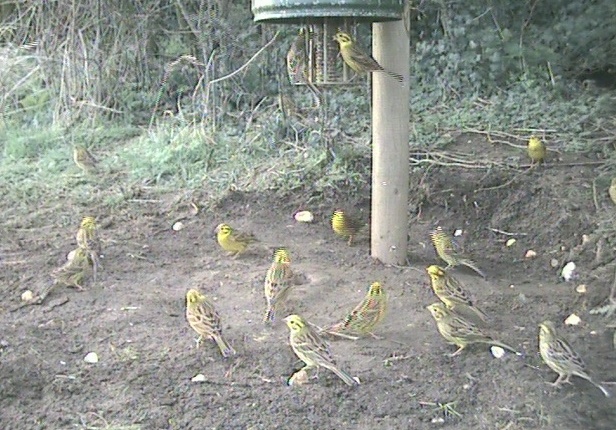
Trail Camera image of yellowhammers feeding at a feeder at Loddington


This encouraging prospect and the current snowy weather have combined to prompt me to dig out some data from several years ago when I first got interested in this issue and started catching yellowhammers through the winter to see how much fat they were carrying.  Birds lay down more fat as the winter progresses - insurance against uncertainty associated with cold weather, shorter days, snow cover and depleted food reserves.  In late winter, fat levels decline and birds become more vulnerable to starvation.


Yellowhammer body condition index, reflecting fat reserves (1995/96 data).


I also have some results for the same period from the Rybachy bird ringing station on the eastern shore of the Baltic.  Fat reserves in yellowhammers are very different here, and considerably higher in the autumn than they are for British birds.  The reason is that Russian birds are laying down fat to fuel a southward migration, rather than to survive the winter on the same site.  There are no data for the winter because the birds have gone!

The low fat levels in the British birds in March serve to highlight the need for supplementary feeding in the scond half of the winter, but especially at the end of the winter when the food supply is at its lowest.  But these data are also a reminder that the same species can behave differently in different countries.